Friday, July 18, 2008

A Bright Day for the Dark Knight


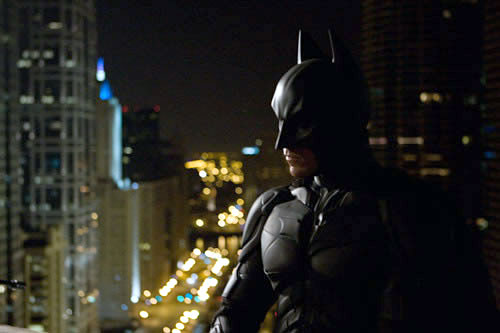
There is a disconnect between Hollywood today and the Hollywood of thirty years ago. Back then, the blockbusters were the award crusaders - films such as Star Wars and Jaws weren't simply summer popcorn fodder, but films that promoted change, entertained, the whole nine yards. Heck. One of those franchises even inspired its own religion. And it doesn't worship giant demonic fish. It would seem that Christopher Nolen found a time machine - because The Dark Knight supremely delivers both.

Over a brooding Gotham City skyline, the dark hero watches a city that has restored to fear and doubt. A lot of sundry men in Joker masks attempt to rob a bank. One by one, they are weeded out by another of their heist group. "You're not needed anymore," they say. "One less share." Only when The Joker enters does the audience see that he is a One Man Act, and that his idea of making writing utensils to disappear is to hide them in men's craniums. Heath Ledger's Joker is not Jack Nicholson's. Ruthless, disturbed, and - oh yes - criminally insane, he makes the average viewer squirm uncomfortably. Are his deeds and actions funny? Certainly not. But seeing a grown man in demonic clown paint and a nurses' uniform brings up a plethora of emotions. And he has this ... thing ... with making sure his victims suffer. "It brings out their true character," says The Joker. Posthumous Oscar nods, anyone?

The film is covered by its overwhelming sense of darkness and doubt. Harvey Dent (Aaron Eckhart) serves as the Beacon of Light in a city where no one knows who will be the next target, the next victim to Drug Lords or Psychosomatic Clowns Gone Awry. Christian Bale's dutiful Batman shines like a ray from the Batlight; the recasting of Maggie Gyllanhaal over Katie Holmes as Rachel Dawes is like Batman choosing his newer, lighter titanium Batsuit. Nowhere in the film are the kitschy references to a comic book, tight spandex costumes, or villains that can be defeated or understood. The Joker uses Gotham as his urban playground, where hubris and human nature collide.

And what of the brooding Batman himself? The guy goes around the entire time playing hero only to realize that Gotham needs someone to look up to, and another to collaborate against, and despise. Guess who's not the White Knight on the shining stallion? It's okay, though, Bat Boy can take the heat.

Seems like there's been some time-travel going on back to the days where Blockbusters are both satisfying and substantial. Go Hollywood. Looks like you've seen the distress signal in the night sky.

Bethertainment Weekly Grade: A
A solid, brooding film that kicks Bat Butt.

Quote of the Day: Harvey Dent: You either die a hero or you live long enough to see yourself become the villain.

Na na na na BATMAN!

Pardon the hiatus in writing. What is 'Bethertainment Weekly' if not a weekly entertainment from my innocuous and inventive self? But the job search continues, and seeing as these United States are in a bit of a pickle financially speaking, jobs are few and far between.

But I digress.

I'm going to see The Dark Knight in a few hours. So expect a fantastic film review. Really.

Sunday, June 29, 2008

(Not) Gone to Pot: Weeds Season One

It seems unlikely that anyone pitching a show would have an easy job of it. A man pitching "Magnum, P.I.," for instance, might say something along the lines of, "...and Tom Selleck will run around in obscenely short shorts and fire guns and solve crimes." That wouldn't fly well. Nor would, "Silver foxes past their prime lounge about and talk of all the hot sex they used to have." So, one might imagine the shock a Showtime executive received when he heard this pitch: "A recently widowed, upper crust Jewish housewife and mother sells pot to her equally upper crust white Jewish friends and gets her dope from wise-cracking Mama, who be calling her a skinny bitch."

And yet, that is the basic premise for Showtime's ingenious series, "Weeds." The pilot wastes no time in semantics and begins in full-fledged medias res. Nancy Botwin (Mary-Louise Parker) lost her husband to a heart-attack witnessed by her youngest son Shane (Finding Nemo's Alexander Gould). She's already selling the MJ to suburban dads at soccer matches, already making pot-lemonade from the metaphoric lemons with which her late husband left her.

The writing is snappy and sharp. (Do the writers not indulge in this mauie wowie, I wonder?) . That doesn't mean that it doesn't veer into well-charted territory. It's as though "Desperate Housewives" moved from Wisteria Lane to Agrestic, California and, rather than sleep with the gardener, they move pot and sleep with the drug lord of the community college. Nancy's friend, or rather, PTA associate Cecelia Hodes (Elizabeth Perkins) is the vindictive, perfectionist mother that hides laxatives in her child's hidden stash of Hershey bars so she'll lose weight. There are cheating husbands, dead husbands, and - most importantly for Nancy - pot smoking husbands.

Nancy must quickly find a covert cover-up business before suspicions start to arise of how she's maintaining her expensive lifestyle. And why not open up a bakery, where her product can be consumed without the damaging affects to the lungs. But things aren't exactly 'smoking' for her.

You've got it all here. Intricate plot, disturbed children who imitate terrorist videos and then wave to Mommy, sexually charged deaf teenagers, and even poop humor. And the added bonus of seeming really cool when you talk about "Weeds" with your friends.

Don't mow the lawn; the grass can wait. It's this entertaining joint where you want to be.

Quote of the Day: Andy Botwin: How can you be so blindly pro-Bush?
Doug Wilson: I like his wife Laura... I used to buy weed from her at SMU.

Tuesday, June 24, 2008

The Dog Days of Summer

Some people tend to be partial to summer. No school, lazy days spent by the pool, no worries. But - of course - that also means no new shows. Yes, as the month of May wanes, so too does the quality of entertainment. Gone are the hopeful Oscar contenders, the art films, and even Blockbusters. In their place are crude facsimiles, usually to do with some talking rodent or a grown man in neon tights. Oh, and lots of explosions and things that go...

BANG!

WHIZ!

BIFF!

No new shows, alas. I am lost without "LOST," I want to be pushing up daisies with no "Pushing Daisies," I'm going mad without "Mad Men." (I won't tell you what activities the lack of "Weeds" encourages). Yes, there are the redemptive media apostles, Jon Stewart and Stephen Colbert - but the world needs more. More than pundit jokes about current events. More than clever taglines and theme music. But ... how? September seems like some sort of unobtainable Grail, an Elysium of plot and character development. Have faith, O ye with anxious eyes and worn sofas.

There is hope.

Here are several ways to hold on:

1. Revisit Old Favorites
What was that one thing that Michael Scott said to Dwight that was just so inappropriate? Or a steamy love scene featuring Jonathon Rhys-Myers? Thanks to modern technology, DVD's allow it. So figure out the mysteries of LOST, find out what made Betty ugly, and see if saving the cheerleader really does mean saving the world. (I'd argue, save the Nielson, save the show, but that's why I'm not an important television executive).

2. Discover Something New (That Might be Old)
There are a wealth of films and television shows that simply go under the radar. Find movies that were nominated for an Oscar but didn't win (some of them simply get the shaft when they are, in fact, the better film) and be amazed. Or, discover the beauty of television gems of yesteryear - "Boomtown," "Freaks and Geeks," and of course - the short-lived but epically entertaining "Cop Rock."

3. Do Something Old-Fashioned
Books. Ever heard of them? Sometimes they're in the pockets of DVD's and explain special features. They are heftier versions of scripts and screenplays. And some of them are pretty entertaining. And then there's hoop-twirling, four-square, and flashlight tag, for starters. For the more advanced, there are regattas, parades, poodle grooming, and French lessons. Très amusant, non?


Be strong. Please, do it for the television.
September will be here before we know it.

Quote of the Day: "Are you blue?"
"Only in color, Michael."

Thursday, June 19, 2008

The Brill and the Aggro - The British Invasion

The Office. The Daily Show. Sanford and Son.

W
hat do these three seemingly unrelated shows have to do with each other?

Is it that they're funny? That they deal with important issues like race, bigotry, and ignorance? That funny front men do inappropriate things?

How about they all hail from a small island in the northern Atlantic where the inhabitants drink tea and use proper grammar? Yes, that's right. Your favourite (as the Brits might spell it) television shows have their roots from Merrie Olde England. If it wasn't apparent with the recent super bands (Coldplay, Radiohead, Snow Patrol), then maybe it's the encroaching fashion. In any case, they came. They saw. They inserted their oddball humour.


The craze started as early as the 1960's and '70's when shows like Sanford and Son emerged after the British Steptoe and Son. Both dealt with racial bigotry and socioeconomic class, sure, but there is the whole accent thing to get around.

Big fan of TLC? Then you'd be a fan of the BBC as well; nearly all of TLC's programming has its roots in British television, from Trading Spaces (British alias Trading Places - see what they did there?) to the more famous What Not to Wear. The British version of the aforementioned is not nearly as polite. The brazen co-hosts, Trinny Woodall and Susannah Constantine, have no qualms against breaking into the victim's changing room and pointing out vast amounts of "poodge" that a pair of capri's are causing. Americans Stacy London and Clinton Kelly tend to tone it down and allow their guests to keep as much dignity as possible. Shut up, Stacy! I'm not even kidding!

And those of you who avidly watch the crazy antics of Jim, Pam, and Michael Scott? It started as the crazy antics of Tim, Emma, and David Brent. Only after a few desperate years did the comedy get transposed for American audiences. (And beer me strength, it did). The quirks and comedy was obviously adapted for American audiences, the insane accents, the obscure slang and the like.

So next time you're enjoying one of the Davids singing on American Idol, remember that it was Pop Idol first; Simon Cowell still offered his capriciously thorny criticisms; the only difference is the contestants on Pop Idol could understand him. So crack open a nice cold Magner's hard cider, pop on the BBC, and keep tuned, in a year or two you might be seeing a doppelganger show stateside.

Quote of the Day: "Bears. Britain. Battlestar Galactica."

Monday, June 16, 2008

"The Bachelorette" Made Me a Widow: Several Reasons Why Reality Television Should be Forgotten like the Hackneyed and Trite Pseudo-Scare of Y2K

A few months ago, I had a behemoth of a cold. We are talking the Hindenburg of nasty viral infections. I was sick as a dog, I should have been quarantined and not have been allowed to resurface until Hilary is elected in office (meaning, of course, never). My point being, I had some unwonted free time, as rare as a lunar eclipse or Brittany Spears wearing more than one layer of clothing. Excellent, I thought. Now I can catch up on all of the quality television shows I’ve missed when I have so diligently been studying 18th Century British Literature.

False.

I turn on the tube only to find a terra nullius of shows—“Survivor,” “Big Brother,” “The Bachelor,” “My Super Sweet 16,” “Next,” – in fact, any show on MTV. (That network, at one point, used to play music, right? Or was that just a Buggles-induced fantasy?) The infamous Writer’s Strike of 2007-2008 had deprived me—and, by proxy—the world, of intelligent, plot-driven shows. Nowhere to be found was “The Office,” “Lost,” “Pushing Daisies,”—anything. It was a vast and desolate wasteland of shoulder cams and cleavage. Studies have shown, people have lost brain cells by watching “Fear Factor.” “Joe Schmo” has been known to cause uncontrollable drooling. And “Flavor of Love” has killed thousands of babies because of its asinine lack of plot and Flava Flav’s wardrobe choices.

Whatever happened to worthwhile, quality television that was both educational and entertaining, that stimulated a few dozen neurons and dendrites while being mildly interesting? While you’re shoving Cool Ranch Doritos in your pie hole with the same lusty vindictiveness in which Gerard Butler slays the Persians in a skimpy man-skirt watching “Big Brother,” is there any activity between thalamus, hypothalamus, and cortex? I’ll take a stab in the dark and say, probably there is not.

But it’s just a hunch.

Though I was young and naïve and had the thin veil of ignorance and callowness and extreme amounts of sugar from Hawaiian Punch, I remember the glory days of “Sesame Street.” And, of course, there was the wonder of “Wishbone,” a mid-90’s PBS show about a literature savy Jack Russel terrier who takes the viewers through lush landscapes of literary masterpieces. Ivanhoe. Paradise Lost. Great Expectations.

Now, the only Great Expectations viewers can hope for include the nagging question if Tela Tequila will ever find true love through the vast sea of sexually confused C-list actors and actresses. It is the basest form of television for those who will not or cannot follow simple story arcs and character development.

ABC recently broadcasted a teaser commercial proclaiming “The Mole” to be “the most fun you’ll have all summer.” Thanks, ABC executives. Why yes, before “The Mole,” the best hope for fun I had this summer was lathering SPF on Great Uncle Al’s back and trimming his nose hair. Geez. Just give me an embolism already.

In specific terms, “Kid Nation” is the Pol Pot of the reality TV show. Not only is it mind-numbingly dull to watch, but there are moral qualms as well. In a word, the show is about forty children, ages 8-15, who are left to their own vices in a ghost town in New Mexico. The ghost town looks suspiciously similar to the set of 3:10 to Yuma. It’s a western Lord of the Flies.

Or it would be, if not for the constant, irritating, and heavy-handed interference of the lobotomized CBS executives. Of course these children are not by themselves. They are surrounded by cameramen, producers, and child psychologists. And, like its’ big brother, “Survivor,” it is not the simple subsistence of surviving on an island or ghost town, but a heavily contrived romp of game-show like challenges and confessionals.

The children are split up into four teams—red, yellow, blue, and green. And from the get go, live, work, and play in these predetermined groups. Moreover, the socioeconomic status for the group is determined who wins the challenges. Say the Blue Team pushed all of their wagons over the finish line first. Then they become the bourgeois, and the others are below them. But do you see the flaw? (Loaded question, yes, but I mean within this context.) This is not a social experiment. It is the basic reinforcement of class and socioeconomics. In a word, it is reiterating the sordid underbelly of the American lifestyle.

The medium of television has allowed for this sort of meta-reality. It is not reality, but neither is it fictitious.

Even if this society would be autonomous—without the interference of ‘grown-up’s,’ there are the moral questions. Has television really sunk so low that they subject children to manipulative submission for the entertainment of a nation? In the “Kid Nation” contract, for example, there is a clause that reads something along the lines of the parents cannot sue and surrender all rights, including but not limited to if their child ingests bleach, looses an appendage, dies, or is sexually assaulted. For that matter, what kind of parent would subject their kid to this? And for a paltry $5,000 stipend, no less.

Excuse me, I need to release my vexation with this show and eat some Teddy Grahams.

It is called the Idiot Box for a reason, yes. But, what of what critics say—that we are in the Second Golden Age of Television? If that is the case, then there are a plethora of shows of which to chose that can be defined as entertaining, but with actual redeeming qualities. (Of course, the media is what I study, so I justify being able to watch 13 hours of straight TV). Post-Writer’s-Strike-Draught, there is a digital Babylon of quality shows. What of “30 Rock,” a wickedly intelligent comedy about writers in New York? Or “LOST,” perhaps the most intricate show to grace television since the dawn of, well, television?

What it boils down to is that people don’t want to have to think when they watch television. It is an escape, a means of travel that doesn’t cost $4.00 a gallon. It takes the viewer from the sofa to an abandoned ranch in New Mexico or an island in the Philippines without the hassle of having to follow intricate plot lines. That is, there is very little invested in reality television. You can just as soon sit down and watch season five of “Big Brother” as the pilot, and understand what is going on. Not so with “24” or “Dexter.” It’s the difference between a seven-course meal versus fries, a burger, and a shake at the local Burgers ‘R Us. One is delicious and takes time to ingest and discern, one is a quick fix.

And Americans have spoken on which of the two they like. Keep your giant hamburger with onion rings and pass me a book.

I think I’ll stay in bed with that cold.